Technique / ObjectContext
Carry identity across a container cut
Retain the same request when moving from isolated input to device context.
Run the original
Original neutral assets · 5.8 seconds · phase values are chosen defaults, not source timings.
npm run render -- ObjectContext out/ObjectContext.mp4 --codec=h264 --mutedDownload the complete pinned project · Inputs, phase meanings & full source code
Official source / inspected interval
Find the perfect gift by shopping with ChatGPT
Watch the official OpenAI upload ↗ · Published 2026-03-27T13:55:13-07:00
Inspected 7.5–11.5 s. Consecutive subset: 8–8.7 s, 42 frames. Dates come from the official watch-page publication field.
Source: OpenAI. Bounded excerpt and annotated stills for the analysis below; not included in the project download.
What changes across the edit
- Shot boundary
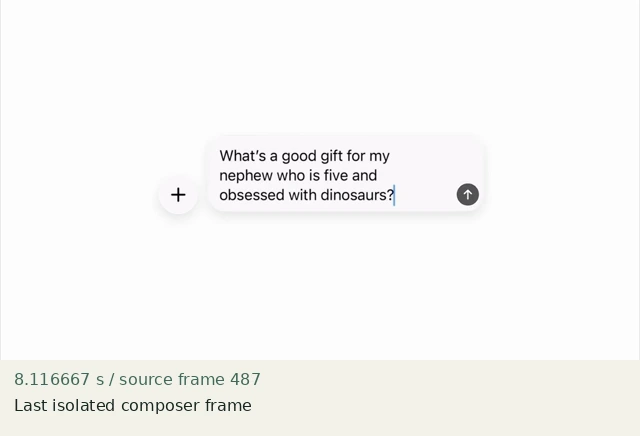
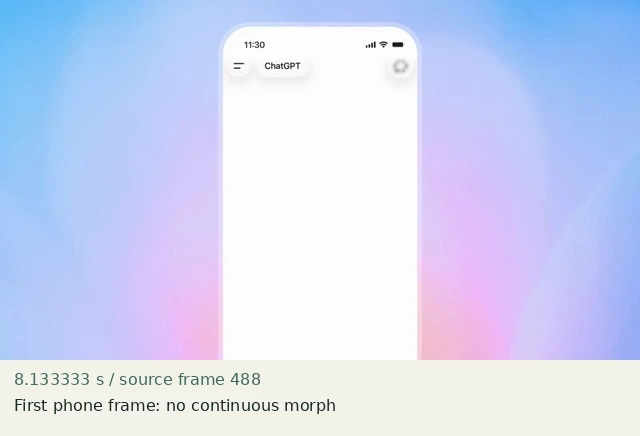
- Source frame 487 at 8.116667 s shows isolated input; frame 488 at 8.133333 s shows an almost-empty phone. No geometric morph connects them.
- Framing
- Readable isolated composer gives way to a smaller request inside a tall phone on a colored field.
- Layer ownership
- White field and composer are replaced by phone and background; the request is introduced within the phone after the cut.
- Motion
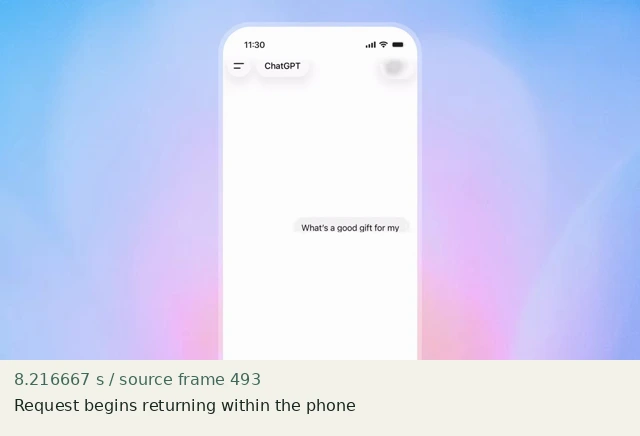
- Phone establishes with changing scale/position, then the request grows into view. The same sentence supplies semantic continuity.
- Typography
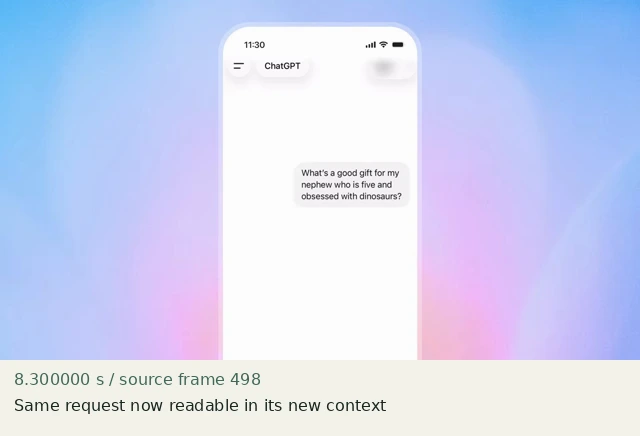
- The same text changes scale and line breaks when it returns; identity does not imply fixed coordinates.
- Action order
- Submitted-looking input → cut → briefly empty phone → same request → later response.
- Pacing & readable holds
- The native frames show request content returning from about 8.216667 s and becoming complete by roughly 8.300 s. No exact product latency is implied.
Recreation versus observation
Matches
Hard container cut, a brief empty-device interval, then the same request returns.
Differs
Original artwork is added as a second continuity cue. Four output frames of empty device and the 30-frame settle interval are chosen, slower than the source.
Measured
- Cut pair 8.116667 / 8.133333 s, frames 487 / 488.
Inferred
- Semantic handoff rather than pixel-matched object motion.
Chosen defaults
All Remotion phase frames, cubic Bézier (.16,1,.3,1), geometry, colors, font choice and reading holds are chosen defaults. None is a recovered OpenAI specification.
{
  "title": "Make room for the idea.",
  "prompt": "Arrange a small exhibition.",
  "result": "Three studies, ready to compare.",
  "label": "EXHIBITION / 03",
  "accent": "#40685b",
  "action": 30,
  "change": 54,
  "settle": 84,
  "hold": 90,
  "focusX": 0.66,
  "focusY": 0.64,
  "zoom": 1.55
}
Increase hold to extend only the final quiet state. Change the phase frames to change choreography; preserve their ordering. Content limits and the exact meaning of each phase are in the handoff.
Exact original geometry, layer ownership and asset contracts · Schedule against an actual recording